
Sixty-five years of water, innovation and world records
On 5 May 1961, engineer Giorgio Colletto founded in Castiglione delle Stiviere, in the province of Mantua, what would become one of the most influential groups in the global aquatic industry. Sixty-five years ago, there was no real private pool market in Italy: there was only an idea, and the determination to bring it to life. The company’s early steps, initially focused on packaging, were far from straightforward. A turning point came with its involvement in the development of a harbour and a hotel on Lake Garda, including the installation of four swimming pools.
Engineer Colletto decided to commercialise pools imported from the United States, launching the Piscine Florida brand. In 1968, the name that would define its future was introduced: Piscine Castiglione, a tribute to the town that hosted the company’s growing entrepreneurial journey. The story then continues with Piscine Castiglione, through its international brand Myrtha Pools, exporting pools to leading universities and some of the most renowned hotels in the United States.
“An important milestone for a family-owned company like ours, now present in 70 markets with 13 branches worldwide. Our history speaks for itself: six Olympic Games, 193 world records achieved in our pools, and dozens of wellness centres and spa facilities developed for major hotel groups. Personally, however, I prefer to look ahead, to the next innovations and the next milestones, as we have always done.”
- Roberto Colletto, CEO Myrtha Pools
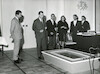
If there is one year that more than any other marks a technological turning point for the group, it is 1977. Following an insight by engineer Colletto, who acquired the Myrtha technology patent and further developed it, a new system was introduced: modular steel panels laminated on the side in contact with water, combined with a high-resistance membrane applied through a thermal process. The result is a unique solution worldwide, combining flexibility, speed of installation and long-term durability. Today, Myrtha technology is reflected in outstanding figures: six Olympic Games (Atlanta 1996, Beijing 2008, London 2012, Rio 2016, Tokyo 2020 and Paris 2024), over 190 world records set in Myrtha pools, and dozens of World Championships hosted.
In 1994, Myrtha made its debut at the FINA World Swimming Championships in Rome, with a self-supporting temporary pool installed on a tennis court at Foro Italico. It was the first of a long series of projects that would redefine the concept of a competition pool. In 1997, the company developed and patented a specific technology for renovating obsolete concrete pools. Once again, thanks to Italian ingenuity and an internal Research & Development team, RenovAction technology was created. This solution reduces costs and construction timelines, as it avoids the complete demolition of end-of-life concrete pools. This aspect continues to underpin its success, also making it a more sustainable choice compared to traditional renovation methods.
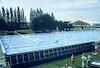
The expansion into the world of major competitions began in 1987, in Strasbourg, with the first temporary pool for the European Swimming Championships. However, it was at Atlanta 1996 that Myrtha confirmed its position on the global stage: the water polo pool was installed in just 12 days, in front of the International Olympic Committee.
From that moment on, a continuous series of pools for major events followed. Myrtha’s exclusive technology makes it possible to avoid the construction of so-called “white elephants”, enabling swimming events to be hosted in large stadiums and arenas using one or more temporary pools. At the end of each event, the pools are dismantled and reinstalled permanently in public facilities, leaving a positive legacy for the host country.
This approach has been widely adopted, particularly in the United States with Olympic Trials, and later by Olympic organising committees: London 2012, with seven temporary pools later distributed across 14 permanent venues in the United Kingdom, Rio 2016, with a total of 18 pools, Tokyo 2020, and finally Paris 2024, the most ambitious and most sustainable edition to date, with 24 pools built, including four temporary pools later reinstalled in suburban areas of Paris as a sporting and social legacy.
The World Championships have been equally significant: from Rome 1994 to Fukuoka 2023, from Montreal 2005, with seven pools and nine world records in a single week, to Singapore 2025, where the partnership between Myrtha Pools and World Aquatics was renewed until 2029. This relationship goes beyond a commercial agreement, reflecting the trust that the international swimming community places in Italian quality.
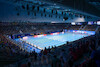
While Myrtha Pools continues to deliver Olympic venues and luxury hospitality projects, the Piscine Castiglione brand continues to focus on what started it all: the italian private pool market. Today, the group has 360 employees, along with 400 agents and distributors, and 13 international branches across 4 continents.
In the wellness and hospitality sector, the brand has become a trusted partner for leading hotel groups such as Marriott, Six Senses, Four Seasons, Hilton, Accor, Baccarat, Jumeirah and Rosewood, as well as global investment funds. Myrtha technology has also been extended to wellness applications, including sauna cabins, steam rooms and experiential showers, suitable for both private use and spa and hotel environments.
The company’s excellence is also reflected in recent awards: Wai Ariki Hot Springs & Spa in New Zealand, recognised at the SPA & Wellness Awards 2025, and the Marriott Como Lake Edition, awarded Best Spa 2026. Not to mention Terme De Montel in Milan, the largest urban thermal park in Italy, featuring 10 Myrtha spa pools.
Innovation has always been part of the company’s DNA: from the Artemis home automation system, which allows private pool management via smartphone, to Myrtha Shark for public pools, capable of optimising filtration and disinfection in real time while reducing water and energy consumption. Some innovations also directly impact health, such as Myrtha Breathe, successfully tested at Paris 2024 and now permanently installed at Boston University, designed to improve indoor air quality with direct benefits for athletes and lifeguards.
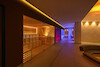
In an industry often associated with high resource consumption, the company has made sustainability a strategic pillar.
The sustainable legacy programme for temporary pools - which are dismantled after major events and reinstalled in new communities, as demonstrated in the case of Paris 2024 - is a model that combines sports performance with social responsibility.
This vision is reflected in both temporary and permanent projects. This is illustrated by the Parramatta Aquatic Centre in Sydney, awarded the IOC IAKS Architecture Prize in 2025, an international recognition for sustainable, accessible and innovative sports facilities. The same focus on reducing impact also guided the Blue Mar Basins project at Celebration Key in the Bahamas, where a large lagoon for Carnival Cruise Line was built, thanks to Myrtha’s self-supporting technology, on a compact soil base (with only 5% cement and the remainder compacted soil), eliminating 14,000 square metres of traditional concrete slab.
Sixty-five years ago, an Italian engineer, Giorgio Colletto, set out to build the best pools possible. Today, that vision has gone beyond expectations: the company operates in over 70 countries, has hosted the greatest swimmers in history, received international architecture awards, and redefined the boundaries of aquatic engineering.
The list of references now exceeds 20,000 installations. The number of world records set in Myrtha pools has surpassed 190.
But for those who work in this group every day, the most important number remains one: the next.


